
The Double-Free That Hands Out root: CVE-2024-1086 in nf_tables
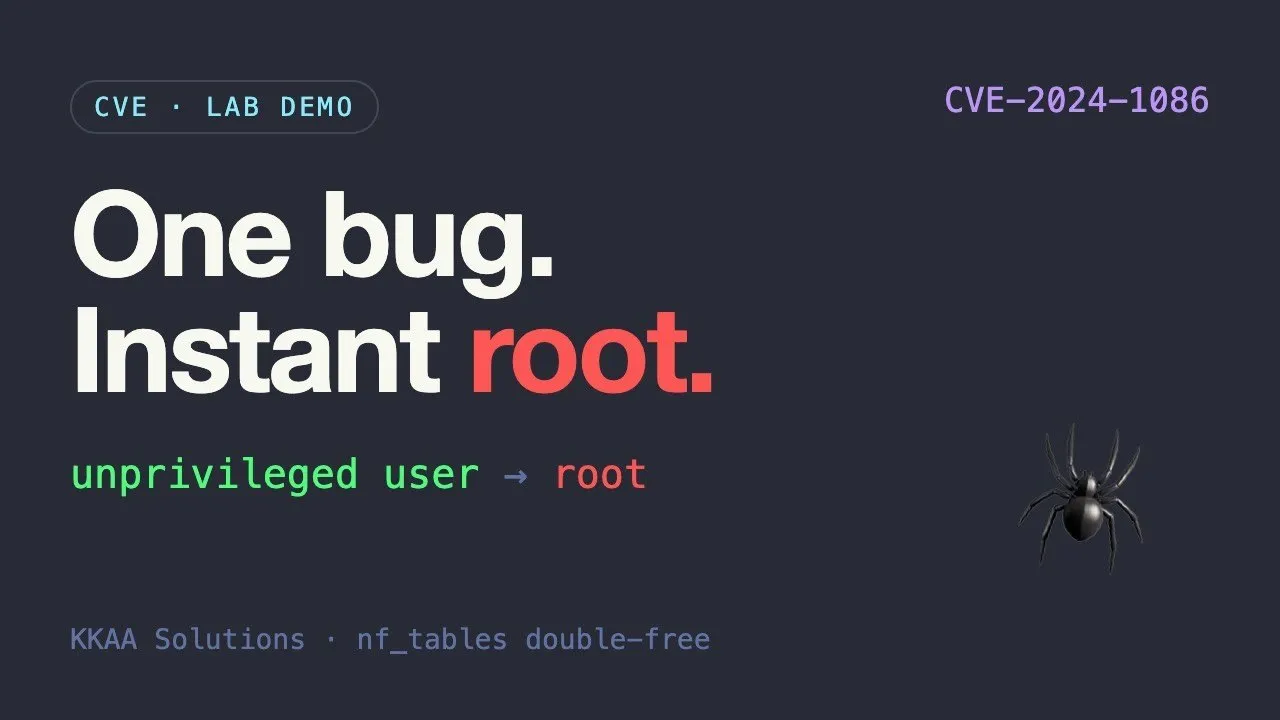
The player loads from YouTube (privacy-enhanced mode) only after you press play. No YouTube cookies are set before that.
What this session covers
CVE-2024-1086 is a use-after-free in nf_tables, the netfilter subsystem built into the Linux kernel. Because the flaw lives in the kernel and can be reached from an unprivileged context, a local user who can run code on the machine can escalate all the way to root. That makes it a shared-hosting and multi-tenant problem as much as a single-server one: any foothold on the box becomes a path to full control. In this session we rebuild the situation in our isolated lab and go through it the way we would explain it to a client.
We start with what the vulnerability actually is and the one precondition that makes it reachable from a normal account: unprivileged user namespaces. We then walk the double-free to use-after-free chain at a conceptual level, using a harmless replica that prints the stages rather than touching kernel memory. The point is to understand why a single freed object can be turned into full control, and to show plainly that our replica leaves the account exactly where it started. We close with the defence: the steps that remove this as a risk today.
Key takeaways
- Patch first. The fix is upstream and in distribution kernels. Updating the kernel and rebooting is what actually removes the flaw; everything else is a reduction of exposure until you can.
- Remove the precondition. The chain needs unprivileged user namespaces. Where your workloads do not need them, disabling them closes the most common route to the bug.
- Depth matters. A local privilege escalation turns any low-privilege foothold into root, so the controls that keep untrusted code off the box in the first place are part of the defence, not separate from it.
- Understand the class, not the weapon. We explain the double-free and the use-after-free so defenders can reason about the fix. No working exploit is shown or provided.
About the lab
Everything in the video runs in a disconnected lab. The "proof of concept" is a benign simulation: it prints the stages of the published technique and a harmless marker, touches no kernel memory, makes no network connection, and runs no exploit. At the end we check the account and it is still an ordinary unprivileged user. Credit for the original analysis goes to the public security research community that documented CVE-2024-1086.
Not sure whether your kernels are exposed to local privilege escalation?
We check kernel and configuration exposure, review the controls that keep untrusted code off your servers, and hand you a written findings list.